
Re: [gpfsug-discuss] WAS: alternative path; Now: RDMA

Jonathan: You posed a reasonable question, which was "when is RDMA worth the hassle?" I agree with part of your premises, which is that it only matters when the bottleneck isn't somewhere else. With a parallel file system, like Scale/GPFS, the absolute performance bottleneck is not the throughput of a single drive. In a majority of Scale/GPFS clusters the network data path is the performance limitation. If they deploy HDR or 100/200/400Gbps Ethernet... At that point, the buffer copy time inside the server matters. When the device is an accelerator, like a GPU, the benefit of RDMA (GDS) is easily demonstrated because it eliminates the bounce copy through the system memory. In our NVIDIA DGX A100 server testing testing we were able to get around 2x the per system throughput by using RDMA direct to GPU (GUP Direct Storage). (Tested on 2 DGX system with 4x HDR links per storage node.) However, your question remains. Synthetic benchmarks are good indicators of technical benefit, but do your users and applications need that extra performance? These are probably only a handful of codes in organizations that need this. However, they are high-value use cases. We have client applications that either read a lot of data semi-randomly and not-cached - think mini-Epics for scaling ML training. Or, demand lowest response time, like production inference on voice recognition and NLP. If anyone has use cases for GPU accelerated codes with truly demanding data needs, please reach out directly. We are looking for more use cases to characterize the benefit for a new paper. f you can provide some code examples, we can help test if RDMA direct to GPU (GPUdirect Storage) is a benefit. Thanks, doug Douglas O'Flaherty douglasof@us.ibm.com ----- Message from Jonathan Buzzard <jonathan.buzzard@strath.ac.uk> on Fri, 10 Dec 2021 00:27:23 +0000 ----- To: gpfsug-discuss@spectrumscale.org Subject: Re: [gpfsug-discuss] On 09/12/2021 16:04, Douglas O'flaherty wrote:
Though not directly about your design, our work with NVIDIA on GPUdirect
Storage and SuperPOD has shown how sensitive RDMA (IB & RoCE) to both MOFED and Firmware version compatibility can be.
I would suggest anyone debugging RDMA issues should look at those closely.
May I ask what are the alleged benefits of using RDMA in GPFS? I can see there would be lower latency over a plain IP Ethernet or IPoIB solution but surely disk latency is going to swamp that? I guess SSD drives might change that calculation but I have never seen proper benchmarks comparing the two, or even better yet all four connection options. Just seems a lot of complexity and fragility for very little gain to me. JAB. -- Jonathan A. Buzzard Tel: +44141-5483420 HPC System Administrator, ARCHIE-WeSt. University of Strathclyde, John Anderson Building, Glasgow. G4 0NG ----- Original message ----- From: "Jonathan Buzzard" <jonathan.buzzard@strath.ac.uk> Sent by: gpfsug-discuss-bounces@spectrumscale.org To: gpfsug-discuss@spectrumscale.org Cc: Subject: [EXTERNAL] Re: [gpfsug-discuss] alternate path between ESS Servers for Datamigration Date: Fri, Dec 10, 2021 10:27 On 09/12/2021 16:04, Douglas O'flaherty wrote:
Though not directly about your design, our work with NVIDIA on GPUdirect Storage and SuperPOD has shown how sensitive RDMA (IB & RoCE) to both MOFED and Firmware version compatibility can be.
I would suggest anyone debugging RDMA issues should look at those
closely.
May I ask what are the alleged benefits of using RDMA in GPFS? I can see there would be lower latency over a plain IP Ethernet or IPoIB solution but surely disk latency is going to swamp that? I guess SSD drives might change that calculation but I have never seen proper benchmarks comparing the two, or even better yet all four connection options. Just seems a lot of complexity and fragility for very little gain to me. JAB. -- Jonathan A. Buzzard Tel: +44141-5483420 HPC System Administrator, ARCHIE-WeSt. University of Strathclyde, John Anderson Building, Glasgow. G4 0NG _______________________________________________ gpfsug-discuss mailing list gpfsug-discuss at spectrumscale.org http://gpfsug.org/mailman/listinfo/gpfsug-discuss

Hello Douglas! May I ask a basic question regarding GPUdirect Storage or all local attached storage like NVME disks. Do you think it outerperforms "classical" shared storagesystems which are attached via FC connected to NSD servers HDR attached? With FC you have also bounce copies and more delay , isn´t it? There are solutions around which work with local NVME disks building some protection level with Raid (or duplication) . I am curious if it would be a better approach than shared storage which has it´s limitation (cost intensive scale out, extra infrstructure, max 64Gb at this time ... ) Best regards Walter From: gpfsug-discuss-bounces@spectrumscale.org <gpfsug-discuss-bounces@spectrumscale.org> On Behalf Of Douglas O'flaherty Sent: Freitag, 10. Dezember 2021 05:24 To: gpfsug-discuss@spectrumscale.org Subject: Re: [gpfsug-discuss] WAS: alternative path; Now: RDMA Jonathan: You posed a reasonable question, which was "when is RDMA worth the hassle?" I agree with part of your premises, which is that it only matters when the bottleneck isn't somewhere else. With a parallel file system, like Scale/GPFS, the absolute performance bottleneck is not the throughput of a single drive. In a majority of Scale/GPFS clusters the network data path is the performance limitation. If they deploy HDR or 100/200/400Gbps Ethernet... At that point, the buffer copy time inside the server matters. When the device is an accelerator, like a GPU, the benefit of RDMA (GDS) is easily demonstrated because it eliminates the bounce copy through the system memory. In our NVIDIA DGX A100 server testing testing we were able to get around 2x the per system throughput by using RDMA direct to GPU (GUP Direct Storage). (Tested on 2 DGX system with 4x HDR links per storage node.) However, your question remains. Synthetic benchmarks are good indicators of technical benefit, but do your users and applications need that extra performance? These are probably only a handful of codes in organizations that need this. However, they are high-value use cases. We have client applications that either read a lot of data semi-randomly and not-cached - think mini-Epics for scaling ML training. Or, demand lowest response time, like production inference on voice recognition and NLP. If anyone has use cases for GPU accelerated codes with truly demanding data needs, please reach out directly. We are looking for more use cases to characterize the benefit for a new paper. f you can provide some code examples, we can help test if RDMA direct to GPU (GPUdirect Storage) is a benefit. Thanks, doug Douglas O'Flaherty douglasof@us.ibm.com<mailto:douglasof@us.ibm.com> ----- Message from Jonathan Buzzard <jonathan.buzzard@strath.ac.uk<mailto:jonathan.buzzard@strath.ac.uk>> on Fri, 10 Dec 2021 00:27:23 +0000 ----- To: gpfsug-discuss@spectrumscale.org<mailto:gpfsug-discuss@spectrumscale.org> Subject: Re: [gpfsug-discuss] On 09/12/2021 16:04, Douglas O'flaherty wrote:
Though not directly about your design, our work with NVIDIA on GPUdirect Storage and SuperPOD has shown how sensitive RDMA (IB & RoCE) to both MOFED and Firmware version compatibility can be.
I would suggest anyone debugging RDMA issues should look at those closely.
May I ask what are the alleged benefits of using RDMA in GPFS? I can see there would be lower latency over a plain IP Ethernet or IPoIB solution but surely disk latency is going to swamp that? I guess SSD drives might change that calculation but I have never seen proper benchmarks comparing the two, or even better yet all four connection options. Just seems a lot of complexity and fragility for very little gain to me. JAB. -- Jonathan A. Buzzard Tel: +44141-5483420 HPC System Administrator, ARCHIE-WeSt. University of Strathclyde, John Anderson Building, Glasgow. G4 0NG ----- Original message ----- From: "Jonathan Buzzard" <jonathan.buzzard@strath.ac.uk<mailto:jonathan.buzzard@strath.ac.uk>> Sent by: gpfsug-discuss-bounces@spectrumscale.org<mailto:gpfsug-discuss-bounces@spectrumscale.org> To: gpfsug-discuss@spectrumscale.org<mailto:gpfsug-discuss@spectrumscale.org> Cc: Subject: [EXTERNAL] Re: [gpfsug-discuss] alternate path between ESS Servers for Datamigration Date: Fri, Dec 10, 2021 10:27 On 09/12/2021 16:04, Douglas O'flaherty wrote:
Though not directly about your design, our work with NVIDIA on GPUdirect Storage and SuperPOD has shown how sensitive RDMA (IB & RoCE) to both MOFED and Firmware version compatibility can be.
I would suggest anyone debugging RDMA issues should look at those closely.
May I ask what are the alleged benefits of using RDMA in GPFS? I can see there would be lower latency over a plain IP Ethernet or IPoIB solution but surely disk latency is going to swamp that? I guess SSD drives might change that calculation but I have never seen proper benchmarks comparing the two, or even better yet all four connection options. Just seems a lot of complexity and fragility for very little gain to me. JAB. -- Jonathan A. Buzzard Tel: +44141-5483420 HPC System Administrator, ARCHIE-WeSt. University of Strathclyde, John Anderson Building, Glasgow. G4 0NG _______________________________________________ gpfsug-discuss mailing list gpfsug-discuss at spectrumscale.org http://gpfsug.org/mailman/listinfo/gpfsug-discuss

Hallo Walter, we had many experiences now to change our Storage-Systems in our Backup-Environment to RDMA-IB with HDR and EDR Connections. What we see now (came from a 16Gbit FC Infrastructure) we enhance our throuhput from 7 GB/s to 30 GB/s. The main reason are the elimination of the driver-layers in the client-systems and make a Buffer to Buffer communication because of RDMA. The latency reduction are significant. Regards Renar. We use now ESS3k and ESS5k systems with 6.1.1.2-Code level. Renar Grunenberg Abteilung Informatik - Betrieb HUK-COBURG Bahnhofsplatz 96444 Coburg Telefon: 09561 96-44110 Telefax: 09561 96-44104 E-Mail: Renar.Grunenberg@huk-coburg.de Internet: www.huk.de ________________________________ HUK-COBURG Haftpflicht-Unterstützungs-Kasse kraftfahrender Beamter Deutschlands a. G. in Coburg Reg.-Gericht Coburg HRB 100; St.-Nr. 9212/101/00021 Sitz der Gesellschaft: Bahnhofsplatz, 96444 Coburg Vorsitzender des Aufsichtsrats: Prof. Dr. Heinrich R. Schradin. Vorstand: Klaus-Jürgen Heitmann (Sprecher), Stefan Gronbach, Dr. Hans Olav Herøy, Dr. Jörg Rheinländer, Thomas Sehn, Daniel Thomas. ________________________________ Diese Nachricht enthält vertrauliche und/oder rechtlich geschützte Informationen. Wenn Sie nicht der richtige Adressat sind oder diese Nachricht irrtümlich erhalten haben, informieren Sie bitte sofort den Absender und vernichten Sie diese Nachricht. Das unerlaubte Kopieren sowie die unbefugte Weitergabe dieser Nachricht ist nicht gestattet. This information may contain confidential and/or privileged information. If you are not the intended recipient (or have received this information in error) please notify the sender immediately and destroy this information. Any unauthorized copying, disclosure or distribution of the material in this information is strictly forbidden. ________________________________ Von: gpfsug-discuss-bounces@spectrumscale.org <gpfsug-discuss-bounces@spectrumscale.org> Im Auftrag von Walter Sklenka Gesendet: Freitag, 10. Dezember 2021 11:17 An: gpfsug-discuss@spectrumscale.org Betreff: Re: [gpfsug-discuss] WAS: alternative path; Now: RDMA Hello Douglas! May I ask a basic question regarding GPUdirect Storage or all local attached storage like NVME disks. Do you think it outerperforms “classical” shared storagesystems which are attached via FC connected to NSD servers HDR attached? With FC you have also bounce copies and more delay , isn´t it? There are solutions around which work with local NVME disks building some protection level with Raid (or duplication) . I am curious if it would be a better approach than shared storage which has it´s limitation (cost intensive scale out, extra infrstructure, max 64Gb at this time … ) Best regards Walter From: gpfsug-discuss-bounces@spectrumscale.org<mailto:gpfsug-discuss-bounces@spectrumscale.org> <gpfsug-discuss-bounces@spectrumscale.org<mailto:gpfsug-discuss-bounces@spectrumscale.org>> On Behalf Of Douglas O'flaherty Sent: Freitag, 10. Dezember 2021 05:24 To: gpfsug-discuss@spectrumscale.org<mailto:gpfsug-discuss@spectrumscale.org> Subject: Re: [gpfsug-discuss] WAS: alternative path; Now: RDMA Jonathan: You posed a reasonable question, which was "when is RDMA worth the hassle?" I agree with part of your premises, which is that it only matters when the bottleneck isn't somewhere else. With a parallel file system, like Scale/GPFS, the absolute performance bottleneck is not the throughput of a single drive. In a majority of Scale/GPFS clusters the network data path is the performance limitation. If they deploy HDR or 100/200/400Gbps Ethernet... At that point, the buffer copy time inside the server matters. When the device is an accelerator, like a GPU, the benefit of RDMA (GDS) is easily demonstrated because it eliminates the bounce copy through the system memory. In our NVIDIA DGX A100 server testing testing we were able to get around 2x the per system throughput by using RDMA direct to GPU (GUP Direct Storage). (Tested on 2 DGX system with 4x HDR links per storage node.) However, your question remains. Synthetic benchmarks are good indicators of technical benefit, but do your users and applications need that extra performance? These are probably only a handful of codes in organizations that need this. However, they are high-value use cases. We have client applications that either read a lot of data semi-randomly and not-cached - think mini-Epics for scaling ML training. Or, demand lowest response time, like production inference on voice recognition and NLP. If anyone has use cases for GPU accelerated codes with truly demanding data needs, please reach out directly. We are looking for more use cases to characterize the benefit for a new paper. f you can provide some code examples, we can help test if RDMA direct to GPU (GPUdirect Storage) is a benefit. Thanks, doug Douglas O'Flaherty douglasof@us.ibm.com<mailto:douglasof@us.ibm.com> ----- Message from Jonathan Buzzard <jonathan.buzzard@strath.ac.uk<mailto:jonathan.buzzard@strath.ac.uk>> on Fri, 10 Dec 2021 00:27:23 +0000 ----- To: gpfsug-discuss@spectrumscale.org<mailto:gpfsug-discuss@spectrumscale.org> Subject: Re: [gpfsug-discuss] On 09/12/2021 16:04, Douglas O'flaherty wrote:
Though not directly about your design, our work with NVIDIA on GPUdirect Storage and SuperPOD has shown how sensitive RDMA (IB & RoCE) to both MOFED and Firmware version compatibility can be.
I would suggest anyone debugging RDMA issues should look at those closely.
May I ask what are the alleged benefits of using RDMA in GPFS? I can see there would be lower latency over a plain IP Ethernet or IPoIB solution but surely disk latency is going to swamp that? I guess SSD drives might change that calculation but I have never seen proper benchmarks comparing the two, or even better yet all four connection options. Just seems a lot of complexity and fragility for very little gain to me. JAB. -- Jonathan A. Buzzard Tel: +44141-5483420 HPC System Administrator, ARCHIE-WeSt. University of Strathclyde, John Anderson Building, Glasgow. G4 0NG ----- Original message ----- From: "Jonathan Buzzard" <jonathan.buzzard@strath.ac.uk<mailto:jonathan.buzzard@strath.ac.uk>> Sent by: gpfsug-discuss-bounces@spectrumscale.org<mailto:gpfsug-discuss-bounces@spectrumscale.org> To: gpfsug-discuss@spectrumscale.org<mailto:gpfsug-discuss@spectrumscale.org> Cc: Subject: [EXTERNAL] Re: [gpfsug-discuss] alternate path between ESS Servers for Datamigration Date: Fri, Dec 10, 2021 10:27 On 09/12/2021 16:04, Douglas O'flaherty wrote:
Though not directly about your design, our work with NVIDIA on GPUdirect Storage and SuperPOD has shown how sensitive RDMA (IB & RoCE) to both MOFED and Firmware version compatibility can be.
I would suggest anyone debugging RDMA issues should look at those closely.
May I ask what are the alleged benefits of using RDMA in GPFS? I can see there would be lower latency over a plain IP Ethernet or IPoIB solution but surely disk latency is going to swamp that? I guess SSD drives might change that calculation but I have never seen proper benchmarks comparing the two, or even better yet all four connection options. Just seems a lot of complexity and fragility for very little gain to me. JAB. -- Jonathan A. Buzzard Tel: +44141-5483420 HPC System Administrator, ARCHIE-WeSt. University of Strathclyde, John Anderson Building, Glasgow. G4 0NG _______________________________________________ gpfsug-discuss mailing list gpfsug-discuss at spectrumscale.org http://gpfsug.org/mailman/listinfo/gpfsug-discuss


I feel the need to respond here... I see many responses on this User Group forum that are dismissive of the fringe / extreme use cases and of the "what do you need that for '' mindset. The thing is that Spectrum Scale is for the extreme, just take the word "Parallel" in the old moniker that was already an extreme use case. If you have a standard workload, then sure most of the complex features of the file system are toys, but many of us DO have extreme workloads where shaking out every ounce of performance is a worthwhile and financially sound endeavor. It is also because of the efforts of those of us living on the cusp of technology that these technologies become mainstream and no-longer extreme. I have an AIX LPAR that traverses more than 300TB+ of data a day on a Spectrum Scale file system, it is fully virtualized, and handles a million files. If that performance level drops, regulatory reports will be late, business decisions won't be current. However, the systems of today and the future have to traverse this much data and if they are slow then they can't keep up with real-time data feeds. So the difference between an RDMA disk IO vs a non RDMA disk IO could possibly mean what level of analytics are done to perform real time fraud prevention. Or at what cost, today many systems achieve this by keeping everything in memory in HUGE farms.. Being able to perform data operations at 30GB/s means you can traverse ALL of the census bureau data for all time from the US Govt in about 2 seconds... that's a pretty substantial capability that moves the bar forward in what we can do from a technology perspective. I just did a technology garage with IBM where we were able to achieve 1.5TB/writes on an encrypted ESS off of a single VMWare Host and 4 VM's over IP... That's over 2PB of data writes a day on a single VM server. Being able to demonstrate that there are production virtualized environments capable of this type of capacity, helps to show where the point of engineering a proper storage architecture outweighs the benefits of just throwing more GPU compute farms at the problem with ever dithering disk I/O. It also helps to demonstrate how a virtual storage optimized farm could be leveraged to host many in-memory or data analytic heavy workloads in a shared configuration. Douglas's response is the right one, how much IO does the application / environment need, it's nice to see Spectrum Scale have the flexibility to deliver. I'm pretty confident that if I can't deliver the required I/O performance on Spectrum Scale, nobody else can on any other storage platform within reasonable limits. Alec Effrat On Thu, Dec 9, 2021 at 8:24 PM Douglas O'flaherty <douglasof@us.ibm.com> wrote:
Jonathan:
You posed a reasonable question, which was "when is RDMA worth the hassle?" I agree with part of your premises, which is that it only matters when the bottleneck isn't somewhere else. With a parallel file system, like Scale/GPFS, the absolute performance bottleneck is not the throughput of a single drive. In a majority of Scale/GPFS clusters the network data path is the performance limitation. If they deploy HDR or 100/200/400Gbps Ethernet... At that point, the buffer copy time inside the server matters.
When the device is an accelerator, like a GPU, the benefit of RDMA (GDS) is easily demonstrated because it eliminates the bounce copy through the system memory. In our NVIDIA DGX A100 server testing testing we were able to get around 2x the per system throughput by using RDMA direct to GPU (GUP Direct Storage). (Tested on 2 DGX system with 4x HDR links per storage node.)
However, your question remains. Synthetic benchmarks are good indicators of technical benefit, but do your users and applications need that extra performance?
These are probably only a handful of codes in organizations that need this. However, they are high-value use cases. We have client applications that either read a lot of data semi-randomly and not-cached - think mini-Epics for scaling ML training. Or, demand lowest response time, like production inference on voice recognition and NLP.
If anyone has use cases for GPU accelerated codes with truly demanding data needs, please reach out directly. We are looking for more use cases to characterize the benefit for a new paper. f you can provide some code examples, we can help test if RDMA direct to GPU (GPUdirect Storage) is a benefit.
Thanks,
doug
Douglas O'Flaherty douglasof@us.ibm.com
----- Message from Jonathan Buzzard <jonathan.buzzard@strath.ac.uk> on Fri, 10 Dec 2021 00:27:23 +0000 -----
*To:* gpfsug-discuss@spectrumscale.org
*Subject:* Re: [gpfsug-discuss] On 09/12/2021 16:04, Douglas O'flaherty wrote:
Though not directly about your design, our work with NVIDIA on GPUdirect Storage and SuperPOD has shown how sensitive RDMA (IB & RoCE) to both MOFED and Firmware version compatibility can be.
I would suggest anyone debugging RDMA issues should look at those
closely.
May I ask what are the alleged benefits of using RDMA in GPFS?
I can see there would be lower latency over a plain IP Ethernet or IPoIB solution but surely disk latency is going to swamp that?
I guess SSD drives might change that calculation but I have never seen proper benchmarks comparing the two, or even better yet all four connection options.
Just seems a lot of complexity and fragility for very little gain to me.
JAB.
-- Jonathan A. Buzzard Tel: +44141-5483420 HPC System Administrator, ARCHIE-WeSt. University of Strathclyde, John Anderson Building, Glasgow. G4 0NG
----- Original message ----- From: "Jonathan Buzzard" <jonathan.buzzard@strath.ac.uk> Sent by: gpfsug-discuss-bounces@spectrumscale.org To: gpfsug-discuss@spectrumscale.org Cc: Subject: [EXTERNAL] Re: [gpfsug-discuss] alternate path between ESS Servers for Datamigration Date: Fri, Dec 10, 2021 10:27
On 09/12/2021 16:04, Douglas O'flaherty wrote:
Though not directly about your design, our work with NVIDIA on GPUdirect Storage and SuperPOD has shown how sensitive RDMA (IB & RoCE) to both MOFED and Firmware version compatibility can be.
I would suggest anyone debugging RDMA issues should look at those
closely.
May I ask what are the alleged benefits of using RDMA in GPFS?
I can see there would be lower latency over a plain IP Ethernet or IPoIB solution but surely disk latency is going to swamp that?
I guess SSD drives might change that calculation but I have never seen proper benchmarks comparing the two, or even better yet all four connection options.
Just seems a lot of complexity and fragility for very little gain to me.
JAB.
-- Jonathan A. Buzzard Tel: +44141-5483420 HPC System Administrator, ARCHIE-WeSt. University of Strathclyde, John Anderson Building, Glasgow. G4 0NG _______________________________________________ gpfsug-discuss mailing list gpfsug-discuss at spectrumscale.org *http://gpfsug.org/mailman/listinfo/gpfsug-discuss* <http://gpfsug.org/mailman/listinfo/gpfsug-discuss>
_______________________________________________ gpfsug-discuss mailing list gpfsug-discuss at spectrumscale.org http://gpfsug.org/mailman/listinfo/gpfsug-discuss

On 12/12/2021 02:19, Alec wrote:
I feel the need to respond here... I see many responses on this User Group forum that are dismissive of the fringe / extreme use cases and of the "what do you need that for '' mindset. The thing is that Spectrum Scale is for the extreme, just take the word "Parallel" in the old moniker that was already an extreme use case.
I wasn't been dismissive, I was asking what the benefits of using RDMA where. There is very little information about it out there and not a lot of comparative benchmarking on it either. Without the benefits being clearly laid out I am unlikely to consider it and might be missing a trick. IBM's literature on the topic is underwhelming to say the least. [SNIP]
I have an AIX LPAR that traverses more than 300TB+ of data a day on a Spectrum Scale file system, it is fully virtualized, and handles a million files. If that performance level drops, regulatory reports will be late, business decisions won't be current. However, the systems of today and the future have to traverse this much data and if they are slow then they can't keep up with real-time data feeds.
I have this nagging suspicion that modern all flash storage systems could deliver that sort of performance without the overhead of a parallel file system. [SNIP]
Douglas's response is the right one, how much IO does the application / environment need, it's nice to see Spectrum Scale have the flexibility to deliver. I'm pretty confident that if I can't deliver the required I/O performance on Spectrum Scale, nobody else can on any other storage platform within reasonable limits.
I would note here that in our *shared HPC* environment I made a very deliberate design decision to attach the compute nodes with 10Gbps Ethernet for storage. Though I would probably pick 25Gbps if we where procuring the system today. There where many reasons behind that, but the main ones being that historical file system performance showed that greater than 99% of the time the file system never got above 20% of it's benchmarked speed. Using 10Gbps Ethernet was not going to be a problem. Secondly by limiting the connection to 10Gbps it stops one person hogging the file system to the detriment of other users. We have seen individual nodes peg their 10Gbps link from time to time, even several nodes at once (jobs from the same user) and had they had access to a 100Gbps storage link that would have been curtains for everyone else's file system usage. At this juncture I would note that the GPFS admin traffic is handled by on separate IP address space on a separate VLAN which we prioritize with QOS on the switches. So even when a node floods it's 10Gbps link for extended periods of time it doesn't get ejected from the cluster. The need for a separate physical network for admin traffic is not necessary in my experience. That said you can do RDMA with Ethernet... Unfortunately the teaching cluster and protocol nodes are on Intel X520's which I don't think do RDMA. Everything is X710's or Mellanox Connect-X4 which definitely do do RDMA. I could upgrade the protocol nodes but the teaching cluster would be a problem. JAB. -- Jonathan A. Buzzard Tel: +44141-5483420 HPC System Administrator, ARCHIE-WeSt. University of Strathclyde, John Anderson Building, Glasgow. G4 0NG
So I never said this node wasn't in a HPC Cluster, it has partners... For our use case however some nodes have very expensive per core software licensing, and we have to weigh the human costs of empowering traditional monolithic code to do the job, or bringing in more users to re-write and maintain distributed code (someone is going to spend the money to get this work done!). So to get the most out of those licensed cores we have designed our virtual compute machine(s) with 128Gbps+ of SAN fabric. Just to achieve our average business day reads it would take 3 of your cluster nodes maxed out 24 hours, or 9 of them in a business day to achieve the same read speeds... and another 4 nodes to handle the writes. I guess HPC is in the eye of the business... In my experience cables and ports are cheaper than servers. The classic shared HPC design you have is being up-ended by the fact that there is so much compute power (cpu and memory) now in the nodes, you can't simply build a system with two storage connections (Noah's ark) and call it a day. If you look at the spec 25Gbps Ethernet is only delivering ~3GB/s (which is just above USB 3.2, and below USB 4). Spectrum Scale does very well for us when met with a fully saturated workload, we maintain one node for SLA and one node for AdHoc workload, and like clockwork the SLA box always steals exactly half the bandwidth when a job fires, so that 1 SLA job can take half the bandwidth and complete compared to the 40 AdHoc jobs on the other node. In newer releases IBM has introduced fileset throttling.... this is very exciting as we can really just design the biggest fattest pipes from VM to Storage and then software define the storage AND the bandwidth from the standard nobody cares about workloads all the way up to the most critical workloads... I don't buy the smaller bandwidth is better, as I see that as just one band-aid that has more elegant solutions, such as simply doing more resource constraints (you can't push the bandwidth if you can't get the CPU...), or using a workload orchestrator such as LSF with limits set, but I also won't say it never makes sense, as well I only know my problems and my solutions. For years the network team wouldn't let users have more than 10mb then 100mb networking as they were always worried about their backend being overwhelmed... I literally had faster home internet service than my work desktop connection at one point in my life.. it was all a falesy, the workload should drive the technology, the technology shouldn't hinder the workload. You can do a simple exercise, try scaling up... imagine your cluster is asked to start computing 100x more work... and that work must be completed on time. Do you simply say let me buy 100x more of everything? Or do you start to look at where can I gain efficiency and what actual bottlenecks do I need to lift... for some of us it's CPU, for some it's Memory, for some it's disk, depending on the work... I'd say the extremely rare case is where you need 100x more of EVERYTHING, but you have to get past the performance of the basic building blocks baked into the cake before you do need to dig deeper into the bottlenecks and it makes practical and financial sense. If your main bottleneck was storage, you'd be asking far different questions about RDMA. Alec On Sun, Dec 12, 2021 at 3:19 AM Jonathan Buzzard < jonathan.buzzard@strath.ac.uk> wrote:
On 12/12/2021 02:19, Alec wrote:
I feel the need to respond here... I see many responses on this User Group forum that are dismissive of the fringe / extreme use cases and of the "what do you need that for '' mindset. The thing is that Spectrum Scale is for the extreme, just take the word "Parallel" in the old moniker that was already an extreme use case.
I wasn't been dismissive, I was asking what the benefits of using RDMA where. There is very little information about it out there and not a lot of comparative benchmarking on it either. Without the benefits being clearly laid out I am unlikely to consider it and might be missing a trick.
IBM's literature on the topic is underwhelming to say the least.
[SNIP]
I have an AIX LPAR that traverses more than 300TB+ of data a day on a Spectrum Scale file system, it is fully virtualized, and handles a million files. If that performance level drops, regulatory reports will be late, business decisions won't be current. However, the systems of today and the future have to traverse this much data and if they are slow then they can't keep up with real-time data feeds.
I have this nagging suspicion that modern all flash storage systems could deliver that sort of performance without the overhead of a parallel file system.
[SNIP]
Douglas's response is the right one, how much IO does the application / environment need, it's nice to see Spectrum Scale have the flexibility to deliver. I'm pretty confident that if I can't deliver the required I/O performance on Spectrum Scale, nobody else can on any other storage platform within reasonable limits.
I would note here that in our *shared HPC* environment I made a very deliberate design decision to attach the compute nodes with 10Gbps Ethernet for storage. Though I would probably pick 25Gbps if we where procuring the system today.
There where many reasons behind that, but the main ones being that historical file system performance showed that greater than 99% of the time the file system never got above 20% of it's benchmarked speed. Using 10Gbps Ethernet was not going to be a problem.
Secondly by limiting the connection to 10Gbps it stops one person hogging the file system to the detriment of other users. We have seen individual nodes peg their 10Gbps link from time to time, even several nodes at once (jobs from the same user) and had they had access to a 100Gbps storage link that would have been curtains for everyone else's file system usage.
At this juncture I would note that the GPFS admin traffic is handled by on separate IP address space on a separate VLAN which we prioritize with QOS on the switches. So even when a node floods it's 10Gbps link for extended periods of time it doesn't get ejected from the cluster. The need for a separate physical network for admin traffic is not necessary in my experience.
That said you can do RDMA with Ethernet... Unfortunately the teaching cluster and protocol nodes are on Intel X520's which I don't think do RDMA. Everything is X710's or Mellanox Connect-X4 which definitely do do RDMA. I could upgrade the protocol nodes but the teaching cluster would be a problem.
JAB.
-- Jonathan A. Buzzard Tel: +44141-5483420 HPC System Administrator, ARCHIE-WeSt. University of Strathclyde, John Anderson Building, Glasgow. G4 0NG _______________________________________________ gpfsug-discuss mailing list gpfsug-discuss at spectrumscale.org http://gpfsug.org/mailman/listinfo/gpfsug-discuss

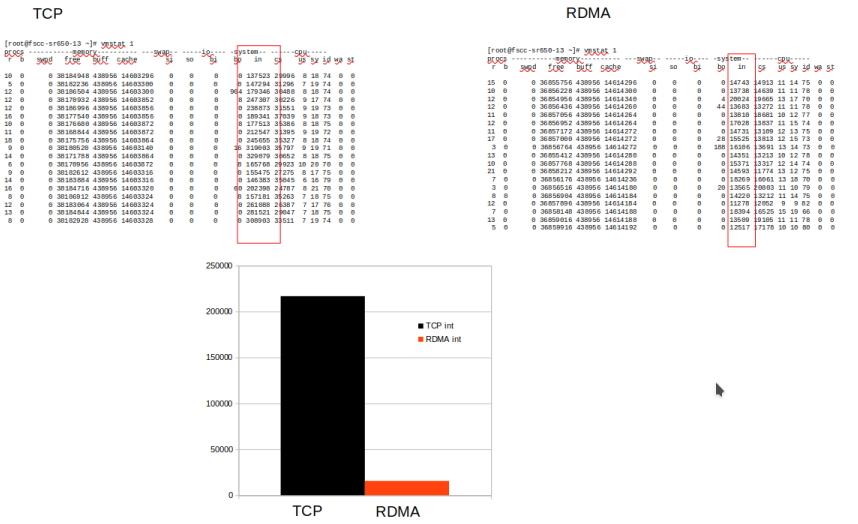
On 13/12/2021 00:03, Andrew Beattie wrote:
What is the main outcome or business requirement of the teaching cluster ( i notice your specific in the use of defining it as a teaching cluster) It is entirely possible that the use case for this cluster does not warrant the use of high speed low latency networking, and it simply needs the benefits of a parallel filesystem.
While we call it the "teaching cluster" it would be more appropriate to call them "teaching nodes" that shares resources (storage and login nodes) with the main research cluster. It's mainly used by undergraduates doing final year projects and M.Sc. students. It's getting a bit long in the tooth now but not many undergraduates have access to a 16 core machine with 64GB of RAM. Even if they did being able to let something go flat out for 48 hours means there personal laptop is available for other things :-) I was just musing that the cards in the teaching nodes being Intel 82599ES would be a stumbling block for RDMA over Ethernet, but on checking the Intel X710 doesn't do RDMA either so it would all be a bust anyway. I was clearly on the crack pipe when I thought they did. So aside from the DSS-G and GPU nodes with Connect-X4 cards nothing does RDMA. [SNIP]
For some of my research clients this is the ability to run 20-30% more compute jobs on the same HPC resources in the same 24H period, which means that they can reduce the amount of time they need on the HPC cluster to get the data results that they are looking for.
Except as I said in our cluster the storage servers have never been maxed out except when running benchmarks. Individual compute nodes have been maxed out (mainly Gaussian writing 800GB temporary files) but as I explained that's a good thing from my perspective because I don't want one or two users to be able to pound the storage into oblivion and cause problems for everyone else. We have enough problems with users tanking the login nodes by running computations on them. That should go away with our upgrade to RHEL8 and the wonders of per user cgroups; me I love systemd. In the end nobody has complained that the storage speed is a problem yet, and putting the metadata on SSD would be my first port of call if they did and funds where available to make things go faster. To be honest I think the users are just happy that GPFS doesn't eat itself and be out of action for a few weeks every couple of years like Lustre did on the previous system. JAB. -- Jonathan A. Buzzard Tel: +44141-5483420 HPC System Administrator, ARCHIE-WeSt. University of Strathclyde, John Anderson Building, Glasgow. G4 0NG
participants (7)
-
 Alec
-
 Andrew Beattie
-
 Douglas O'flaherty
-
 Grunenberg, Renar
-
 Jonathan Buzzard
-
 Olaf Weiser
-
 Walter Sklenka